How Big is Texas? You Won’t Believe How Huge It Is!
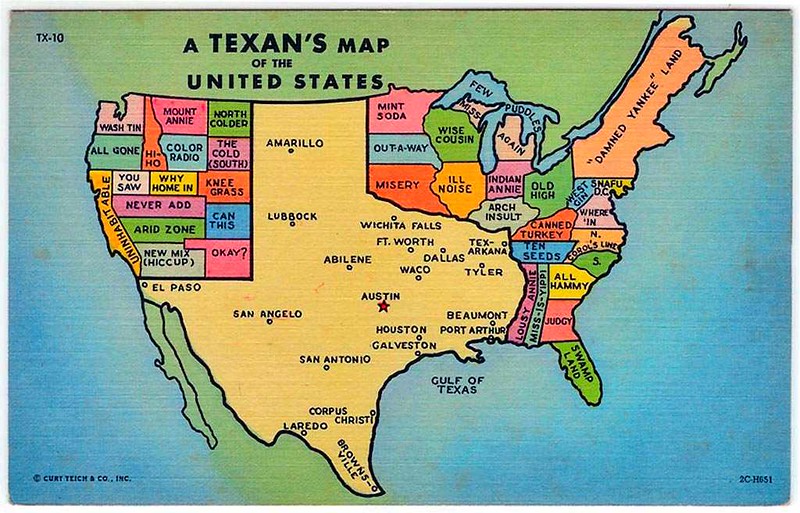
Texas is the second-largest state in the United States, covering 268,596 square miles, or about 171.9 million acres. It's about 1.6 times the size of California (163,696 square miles). Only Alaska is bigger: at 665,384 square miles, it's nearly 2.5 times the size of Texas.
Texas is big in other ways, too. About 31.7 million people lived in Texas in 2025, second only to California, and the state's economy reached $2.9 trillion. If Texas were its own country, that economy would rank about eighth in the world, ahead of Italy, Russia and Canada.
Figures in this article come from the U.S. Census Bureau, the IMF and other official sources, and were last checked in October 2026. Comparisons note whether they use total area (land plus water) or land area only.
Why is Texas So Big?
Most U.S. states were carved out of large federal territories, which Congress divided into smaller pieces. Texas took a different path. It was already an independent nation, the Republic of Texas, when it joined the Union in 1845, so it came in whole.
At one time, the Republic of Texas claimed land that's now part of New Mexico, Colorado, Oklahoma, Kansas and Wyoming. Under the Compromise of 1850, Texas gave up those claims in exchange for $10 million from the federal government to help pay off its old Republic debts. Even after that, Texas remained enormous.
How Big is Texas Compared to the United States?
- Area: Texas covers about 7% of the total area of the United States (about 3.8 million square miles). The U.S. is roughly 14 times the size of Texas.
- Population: Texas is home to about 9.3% of all Americans.
- Economy: Texas produces about 9.5% of the nation's economic output.
25 Little-Known Facts About the Size of Texas
- Texas could hold nearly everyone on Earth. If people were packed in as densely as in New York City (about 29,300 people per square mile), Texas's land could hold roughly 7.7 billion people. That's almost the whole world population of about 8.2 billion.
- If Texas were a country, it would rank about 40th in area out of the world's 193 United Nations member countries. It would be larger than any country located entirely in Europe.
- Fifteen states could fit inside Texas at the same time. By land area, Rhode Island, Delaware, Connecticut, Hawaii, New Jersey, Massachusetts, New Hampshire, Vermont, Maryland, West Virginia, South Carolina, Maine, Indiana, Kentucky and Virginia together add up to less land than Texas.
- Texas has 254 counties, more than any other state.
- Brewster County, the state's largest county, is bigger than Connecticut. At about 6,192 square miles, it's more than 500 square miles larger than the Nutmeg State and over three times the size of Delaware.
- Even Harris County, home to Houston, is bigger than Rhode Island. It has about 1,707 square miles of land, while Rhode Island's total area is about 1,545 square miles.
- Big Texas, tiny towns. Loving County in West Texas had just 64 residents at the 2020 Census, the fewest of any county in the nation.
- The King Ranch covers about 825,000 acres, nearly 1,300 square miles. That's more land than Rhode Island has.
- Big Bend National Park covers more than 800,000 acres, about 1,250 square miles.
- The Texas land area is larger than New England, New York, Pennsylvania, Ohio and Illinois combined. Those ten states have about 251,000 square miles of land; Texas has about 261,000.
- Texas has the highest posted speed limit in the nation. A 41-mile stretch of the State Highway 130 toll road between the Austin area and Seguin allows drivers to go 85 mph.
- U.S. 83 is the longest highway in Texas. It runs about 906 miles from the Oklahoma line near Perryton to Brownsville on the Mexican border.
- Interstate 10 runs about 880 miles across Texas, from El Paso to the Louisiana line near Orange.
- Texas has more miles of public roads, more airports and more freight rail than any other state.
- El Paso is closer to Denver than it is to Houston. As the crow flies, it's about 557 miles to Denver and about 674 miles to Houston.
- El Paso is also closer to San Diego, California (about 627 miles) than to Texarkana, Texas (about 733 miles).
- Texas spans two time zones. El Paso and Hudspeth counties in far West Texas run on Mountain Time; the rest of the state is on Central Time.
- Texas's border is about 4,137 miles long. That includes about 1,254 miles along the Rio Grande and Mexico and about 367 miles of Gulf coastline.
- The geographic center of Texas is in McCulloch County, about 15 miles northeast of Brady. A historical marker shows the spot.
- The "Texas Triangle" is home to about two-thirds of all Texans. More than 21 million people live in the region formed by Dallas–Fort Worth, Houston, San Antonio and Austin.
- DFW International Airport covers 17,207 acres, about 27 square miles, which makes it larger than the island of Manhattan.
- The Texas Capitol is the largest state capitol in gross square footage, and it stands about 15 feet taller than the U.S. Capitol in Washington, D.C.
- Padre Island is the longest barrier island in the world and the second-largest island in the lower 48 states, behind only New York's Long Island.
- Palo Duro Canyon in the Panhandle is the second-largest canyon in the country, about 120 miles long and up to 800 feet deep.
- Farms and ranches cover about 125.5 million acres of Texas, nearly three-quarters of the state. Texas has more farms (about 230,000) than any other state.
How Many States Can Fit in Texas?
Every state except Alaska could fit inside Texas on its own. California, the third-largest state, fits about 1.6 times. Rhode Island, the smallest state, would fit into Texas about 174 times by total area.
And, as noted above, by land area the 15 states listed in fact #3 could all fit inside Texas at once, with room to spare.
Is Texas Bigger Than England?
Much bigger. England covers about 50,346 square miles, so Texas is more than five times its size.
- Capital vs. largest city: London covers slightly less land than the city of Houston. But London is home to about 9 million people, while Houston has about 2.4 million.
- Population: England has about 58.6 million people (mid-2024), nearly twice as many as Texas.
What Country is the Same Size as Texas?
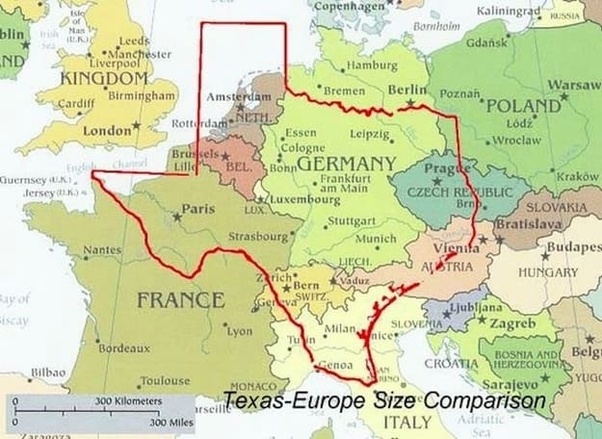
Great map demonstrating the size of Texas vs various European Countries
A few countries come close:
- Myanmar: about 261,228 square miles, nearly a perfect match
- Afghanistan: about 251,827 square miles
- Zambia: about 290,587 square miles, slightly larger
- France: about 248,573 square miles including its overseas regions; mainland France alone is about 213,000 square miles
Is Texas Bigger Than the UK?
Yes. The United Kingdom covers about 93,628 square miles, so Texas is nearly three times as big.
- Population: The UK has about 69.3 million people (mid-2024), roughly 2.2 times as many as Texas.
- Economy: The UK's 2025 GDP of about $4.0 trillion is roughly 36% larger than Texas's $2.9 trillion.
Is Texas Bigger Than France?
Yes. Texas is about 26% larger than mainland France (about 213,000 square miles). Even counting France's overseas regions (about 248,573 square miles), Texas is still about 8% larger.
- Population: France has about 68 million people, a little more than twice the population of Texas.
- Economy: France's 2025 GDP of about $3.4 trillion is roughly 16% larger than Texas's.
Is Texas Bigger Than Germany?
Yes. Germany covers about 137,988 square miles, so Texas is nearly twice its size.
- Population: Germany has about 83 million people, roughly 2.6 times as many as Texas.
- Economy: Germany's 2025 GDP of about $5.0 trillion is roughly 73% larger than Texas's.
Is Texas Bigger Than Japan?
Yes. Japan covers about 145,937 square miles, so Texas is about 84% larger.
- Population: Japan has about 124 million people, nearly four times as many as Texas packed into a little over half the space.
- Economy: Japan's 2025 GDP of about $4.3 trillion is roughly 47% larger than Texas's.
Which is Bigger: Texas or California?
Texas, by a lot. At 268,596 square miles, Texas is about 64% larger than California (163,696 square miles).
- Population: California has about 39.4 million people (2025), about 24% more than Texas's 31.7 million.
- Density: Texas averages about 121 people per square mile of land; California averages about 253.
- Economy: California's 2025 GDP of about $4.3 trillion is roughly 46% larger than Texas's $2.9 trillion.
How Many Acres is Texas?
Texas covers about 171.9 million acres in total (268,596 square miles × 640 acres per square mile).
How Long Does it Take to Drive Across Texas, East to West?
From El Paso, take I-10 east for about 165 miles, then pick up I-20 and follow it through Midland, Odessa, Abilene and the Dallas–Fort Worth Metroplex to Waskom on the Louisiana line. That's about 800 miles and roughly 12 hours behind the wheel, plus time for gas and food. At its widest point, Texas measures about 773 miles from east to west.
How Long Does it Take to Drive Across Texas, North to South?
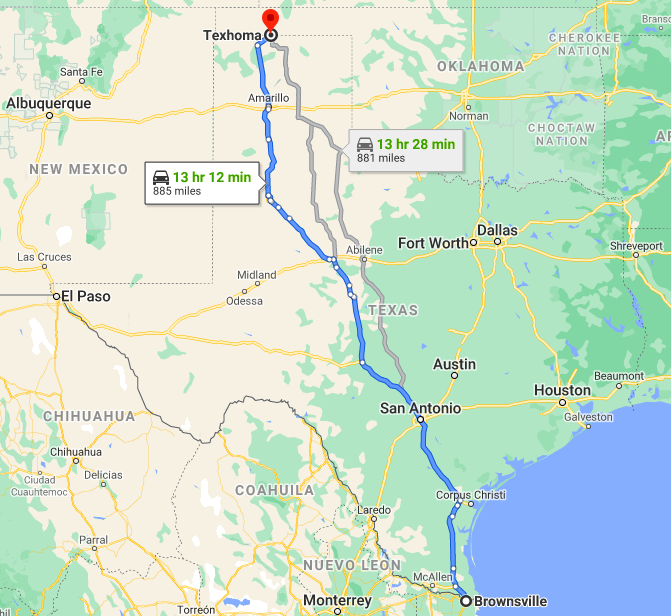
Driving from Texhoma at the top of the Panhandle to Brownsville at the southern tip, by way of Amarillo, Lubbock and San Antonio, covers well over 850 miles. Plan on 13 to 14 hours of driving, and closer to 15 or 16 with stops. As the crow flies, Texas measures about 801 miles from north to south.

If you are interested in what it might look like to drive across Texas on I-10 from El Paso through Houston, check out this cool timelapse video.
How long does it take to drive across Texas, North to South?
Driving from Texhoma at the top of the Panhandle to Brownsville at the southern tip, by way of Amarillo, Lubbock and San Antonio, covers well over 850 miles. Plan on 13 to 14 hours of driving, and closer to 15 or 16 with stops. As the crow flies, Texas measures about 801 miles from north to south.
Sources
U.S. Census Bureau (QuickFacts, Vintage 2025 estimates, 2020 Census land areas); International Monetary Fund (2025 nominal GDP); U.S. Bureau of Economic Analysis; Office for National Statistics (UK, mid-2024 estimates); Texas Historical Commission; Texas State Historical Association; Texas State Preservation Board; National Park Service; USDA 2022 Census of Agriculture; Office of the Texas Governor; Texas 2036.
More from the almanac

Culture · History
Why is Texas called the Lone Star State?
Culture · Events
Lone Star Percussion Closed: The End of an Era
Culture · History
50 Songs About Texas That You’ll Never Forget